1 Jun 2022 · sven@coursy.io
Why technology doesn’t do the learning?

By Marko Vene
Combining technology and content is common practice in e-learning. This is a great formula for providing information online, but there is a lot more to learning.
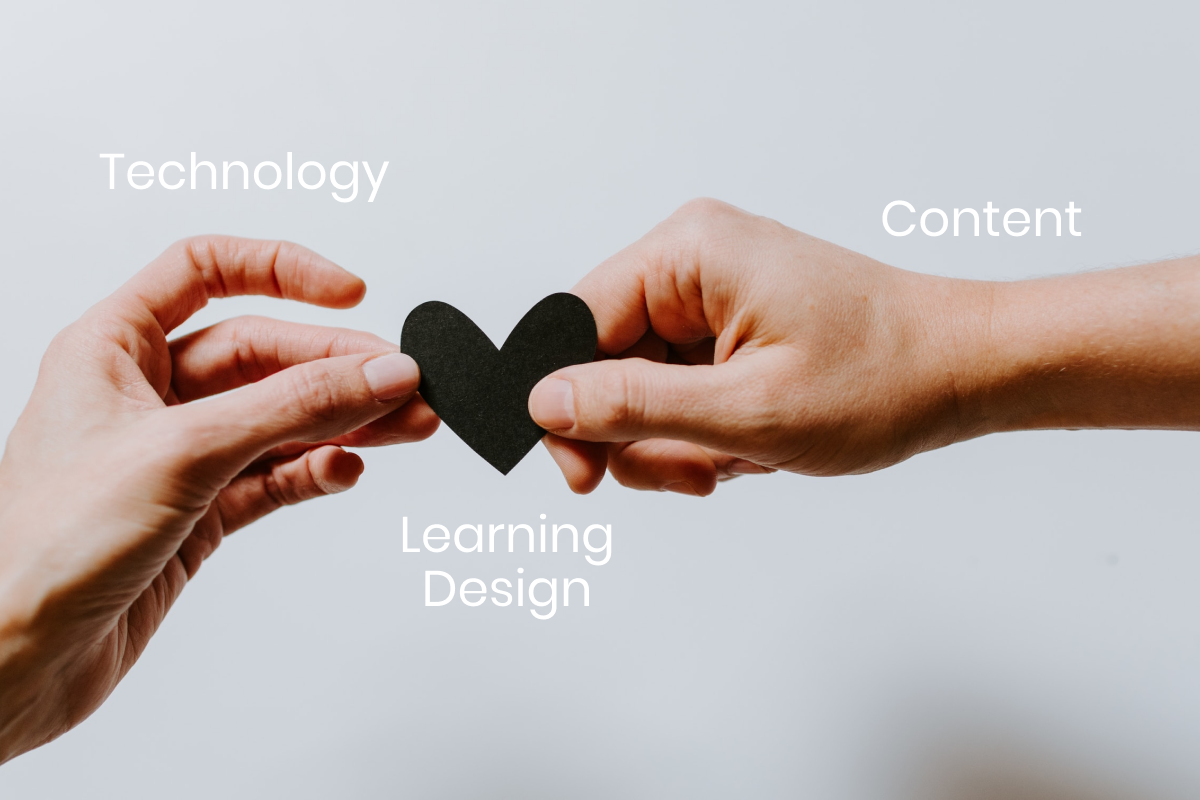
The success lies in the third component – learning design.
But what does it really mean and how to implement the principles of learning design?
The basics of learning
The learner, and the purpose of the learning, more than anything else, should determine the learning design. So it all starts from the understanding who are learners. Some still see them as empty canisters to be filled with content. Learning professionals see them from a slightly different angle. Malcolm Knowles, who is considered the father of adult learning theory, has made the 6 assumptions:
- Need to know: Adults need to know the reason for learning something.
- Foundation: Experience provides the basis for learning activities.
- Self-concept: Adults need to be responsible for their decisions on education; involvement in the planning and evaluation of their instruction.
- Readiness: Adults are most interested in learning subjects having immediate relevance to their work and/or personal lives.
- Orientation: Adult learning is problem-centered rather than content-oriented.
- Motivation: Adults respond better to internal versus external motivators.
Okay. We know who are learners, but how they learn?
Let’s look at what learning is not about and what it really is
Learning is not a process for transferring knowledge from A to B, like the traditional sender–receiver model for communication.
Learning is an active, individual process through which the person is changed, taking place through lived experiences (Jarvis).

What is the problem with first understanding so many folks seem to share? It is not enough simply to assign or automate information in order to achieve learning. Somehow there is an assumption that if we just expose learners to content, learning will happen. It won’t. Information and ability to remember this information is only the premise of learning.
We need to understand that learning is an active process where experience has a central part. And if we talk about experience, we have to remember one thing: learners are connected to their experience through the reflection of that experience, and learning takes place through reflection.
This is part one of a three-part article. Read the second part here and the hird part here.
Leave us your e-mail to receive a full text to your mailbox.
Need learning design? Learn more about additional services to get the best results.